Author: Maria Souza

YoPA in Soweto celebrates intervention with a hiking trip

November 26th, 2025

The YoPA team in Soweto has proudly concluded both the intervention and control group programmes with an exciting outdoor field trip, where participants enjoyed a refreshing and energetic hiking experience.

The groups—composed of youth aged 12 to 18—completed their hikes at different times, with the intervention group taking to the trails at the end of August 2025, followed by the control group at the end of October. Both hikes offered participants a chance to connect with nature, strengthen peer bonds, and celebrate their journey in the project.

This milestone marks the second last session of the YoPA programme in Soweto, and the successful completion of the hikes reflects the positive engagement, commitment, and overall success of the project in the community.

YoPA in Nigeria had an advocacy visit to the Ministry of Education

November 26th, 2025

An advocacy visit was made to the Osun State Ministry of Education in Nigeria to provide updates on the project’s progress, key achievements, and upcoming implementation phase.

The YoPA team from Redeemer’s University and VARCE met with senior officials from the Ministry, including the Director of Public Schools, the Adolescent and Wellness Officer, and the Deputy Director of Science, Mathematics, and Technology.

The meeting served as an important platform to strengthen collaboration with policymakers and to emphasise their crucial roles in implementing and sustaining the interventions in Osun State.

YoPA in Nigeria begins implementation phase

November 26th, 2025

The intervention phase of the YoPA project in Nigeria officially began on October 6, 2025, with students from the intervention site and the control site. A hundred and ten adolescents (between 11 and 18 years old) were selected from each site, from both the junior secondary school and the senior secondary school.

A successful introductory session was held for students at both sites. The session provided a warm and engaging atmosphere where students were introduced to the project’s goals, structure, and expectations. It also offered an important opportunity to build rapport, clarify roles, and spark enthusiasm among the teenagers. To ensure ethical participation, consent forms were distributed for parents and guardians, reinforcing the project’s commitment to voluntary and informed involvement.

The students’ energy, curiosity, and openness during the session were truly remarkable—highlighting their excitement for the journey ahead and their confidence in the positive impact the YoPA project aims to create.

YoPA at the 4th International Conference on Sports and Education

November 18th, 2025

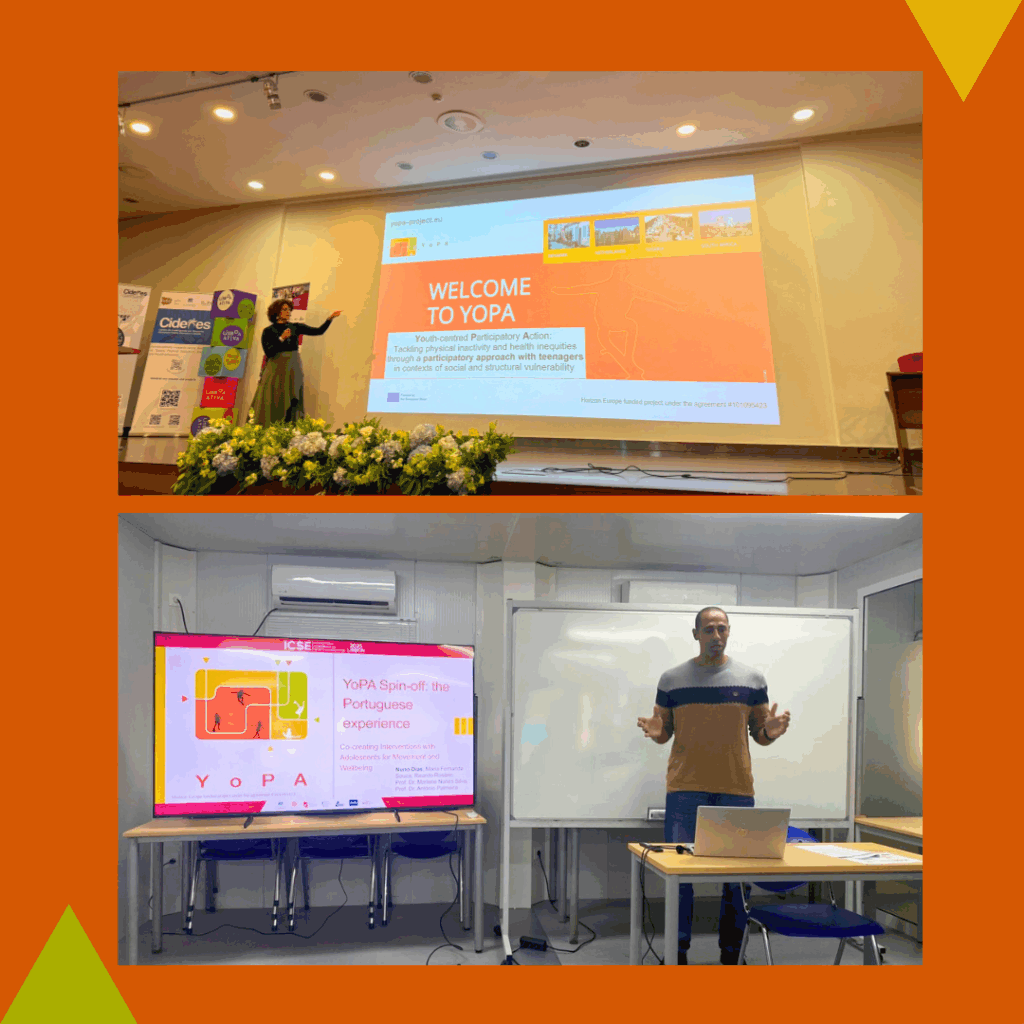
On November 14th and 15th, Lusófona University in Lisbon hosted the 4th edition of the International Conference on Sports and Education (ICSE), where the YoPA project was strongly represented.

PhD students Maria Fernanda Souza and Nuno Dias delivered two oral presentations.
Fernanda presented her YoPA study (now in its final stage), focused on identifying barriers and facilitators during the first co-creation phase. Nuno shared the progress of the Portuguese YoPA spin-off, highlighting achievements to date and the upcoming steps.

The audience response was highly positive.

Supervisors and YoPA consortium members, Professors António Palmeira and Marlene Silva also contributed to the event through panel moderation and poster evaluation, further strengthening YoPA’s presence.

Another important step in disseminating the YoPA approach within the international research community and beyond!

YoPA published a new article on Health Promotion International journal

October 27th, 2025

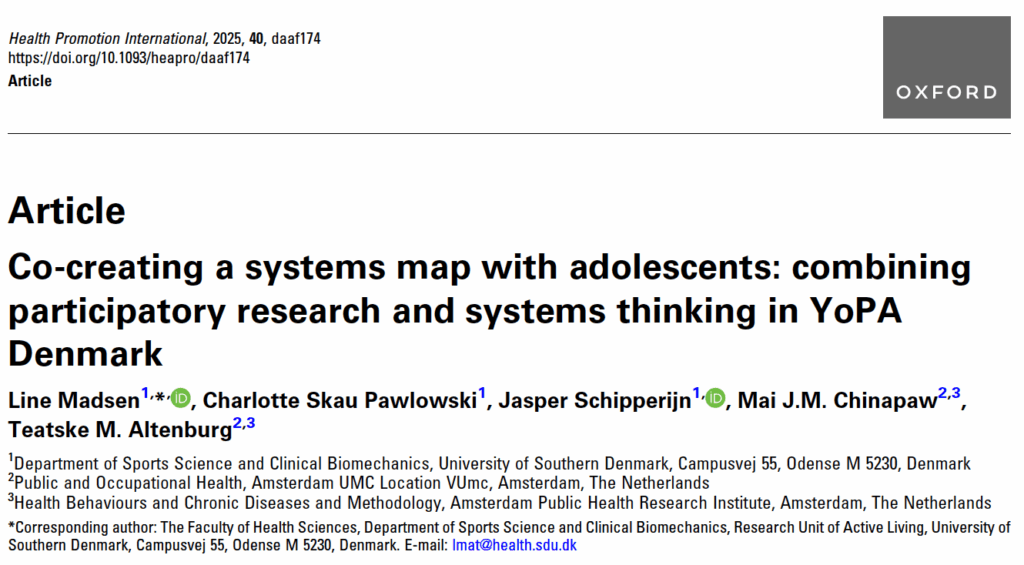
YoPA has recently published a peer-reviewed article in Health Promotion International titled “Co-creating a systems map with adolescents: combining participatory research and systems thinking in YoPA Denmark”.

Led by the PhD student in YoPA Denmark, Line Madsen, and co-authored by some of YoPA’s senior researchers, this study presents the co-created systems map that illustrates the complex interplay of factors influencing physical activity behaviours of local youth, and describes the process of its development.

Key highlights

  • Adolescents worked alongside researchers to map out the factors – from social networks and school routines to neighbourhood design and digital habits – that affect their movement and non-movement.
  • The study demonstrates how systems mapping can illuminate leverage points for intervention that might otherwise remain hidden when using traditional linear models.
  • The findings reinforce that promoting physical activity among young people is not just a matter of motivating individuals, but of reshaping the context in which they live, learn and move.
  • Importantly for our equity-oriented community: the research underscores how factors such as access to safe public spaces, educational settings, and participatory processes influence outcomes – reinforcing the call for structural as well as behavioural solutions.

Read the article

You can access the full article here.
(If you don’t have access through your institution, please contact us and we’ll try to facilitate.)